Today's What Nobody Tells You is about Operational Insight

What Nobody Tells You About IT Training Budgets

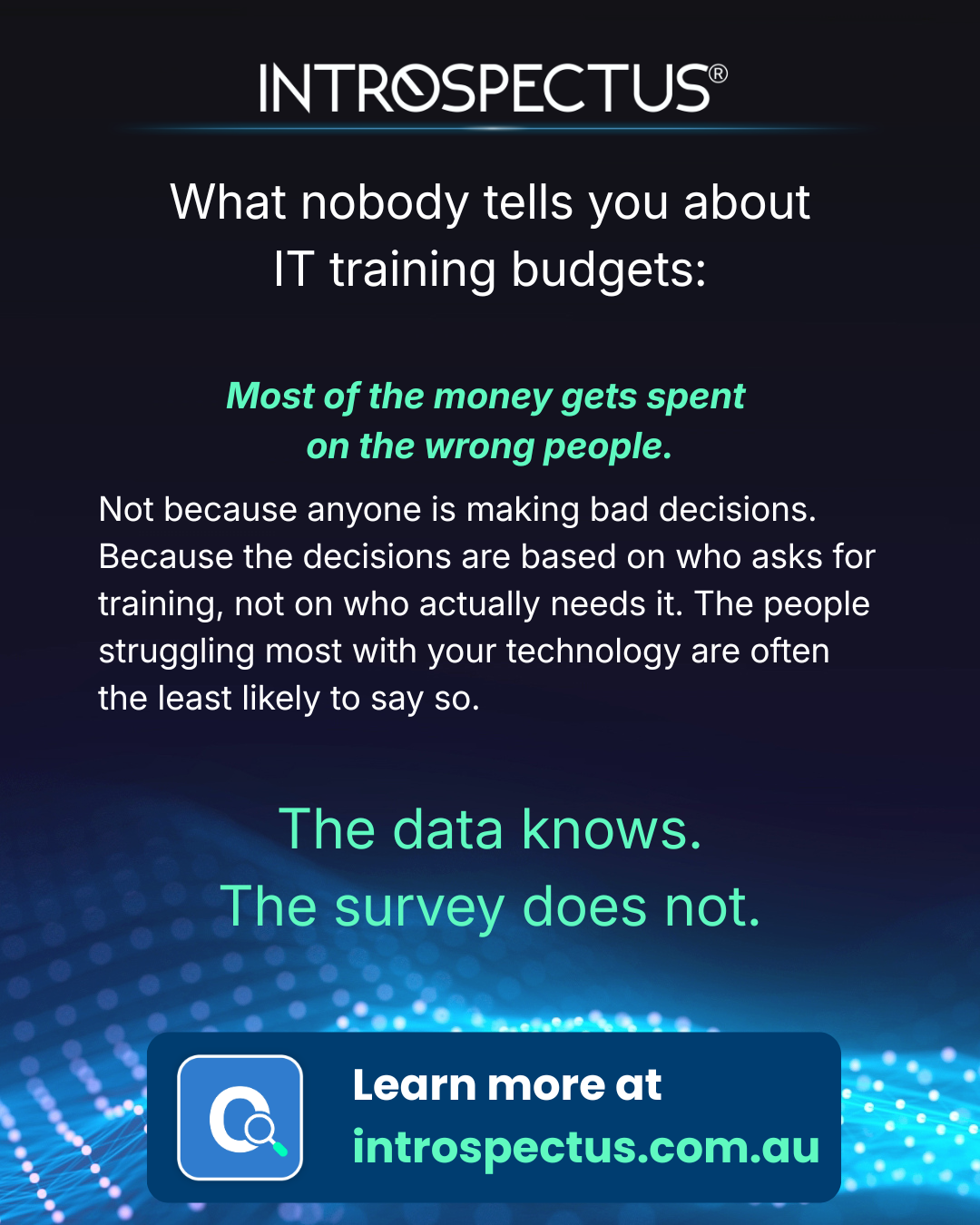
Most of the money gets spent on the wrong people Training budgets tend to go to the people who speak up. That sounds reasonable until you realise that the people who speak up are rarely the ones struggling the most.

Confident users ask for advanced training. Quiet users say nothing, find workarounds, and fall further behind. Managers recommend training for the people they notice, which tends to be the ones already performing well. The real gaps stay hidden because the people experiencing them do not flag them and the systems do not surface them.


Not because anyone is making bad decisions. Because the decisions are based on who asks for training, not on who actually needs it.


Why the gaps stay invisible
It is not a failure of management or a lack of care. It is simply how self-reporting works. Someone who is confident with a piece of software is comfortable putting their hand up and asking to go further. Someone who is quietly struggling has often built a workaround that hides the problem, sometimes even from themselves. They are not being evasive. They have simply found a way to get by, and getting by does not look like a training request.

Add to that the natural bias of a manager’s attention. It is easier to notice and support the people who are already visible and performing well than to notice the quiet gaps in someone who is keeping their head down. So the budget follows visibility, not need.


The result is a budget that reinforces strengths instead of closing gaps
The outcome is a training program that feels productive. Sessions get booked, certificates get issued, feedback forms come back positive. But the problems the budget was meant to solve are often still there, just as they were before, because the people who needed help the most were never in the room.


The data knows. The survey does not.

Surveys and self-nominations rely on people accurately identifying and reporting their own gaps. Usage data does not have that problem. It shows, objectively, which applications are opened and abandoned, which features are never touched, and which workflows are being worked around rather than worked with.


Introspectus Operational Insight shows you which applications people avoid, struggle with, or misuse, so training decisions are built on evidence rather than assumption. Instead of guessing who needs help based on who asks for it, you can see exactly where the friction is and direct your training budget to where it will actually make a difference.

How Introspectus Helps

Each agent compares the current patch list against what is actually installed on its device. Any gap between what has been released and what is deployed is immediately surfaced. Critically, Introspectus pays particular attention to the timing of patch deployment not just whether a patch is present, but when it was applied.

This temporal dimension is central to Essential Eight compliance, where the difference between a patch applied on day two versus day thirty can mean the difference between maturity levels, and between an environment that was protected and one that was exposed.

This combination of daily patch intelligence, severity-based filtering, agent-level validation, and deployment timing analysis gives organisations a real-time, evidence-based view of their operating system patch posture mapped directly to the ISM controls applicable to the Essential Eight patch operating systems strategy.

The Challenge with Patch Operating Systems

The visibility gap here is particularly consequential. A patch may be approved and scheduled, yet never successfully applied due to a failed deployment, a device that was offline during the maintenance window, a reboot that was deferred, or a system that exists outside managed channels entirely.

Organisations that rely solely on deployment tooling to confirm patch status are measuring intent, not reality. The ACSC is explicit on this point: organisations need to confirm patches have been applied successfully, not merely that they were dispatched.

Patch Operating Systems Overview

Within the Essential Eight framework, patching operating systems is a core and non-negotiable control. The ACSC sets clear expectations: patches for internet-facing infrastructure must be applied within 48 hours when identified as critical or where working exploits exist, and within two weeks for standard releases.

Patches for workstations, servers, and network devices must be applied within one month, with tighter timeframes applying in high-threat environments. Critically, the ACSC also mandates that vulnerability scanning occurs at least daily for internet-facing systems and at least fortnightly for workstations and non-internet-facing infrastructure not to replace patching, but to confirm it has actually occurred.

How Introspectus Works

From this inventory, Introspectus performs targeted web intelligence gathering. For each application identified, the platform locates the top five authoritative sources of patch and release information vendor security advisories, release notes, and vulnerability databases and retrieves that content into a central repository.

Aletheia, Introspectus’s AI analysis agent, then reads and analyses this content to extract the intelligence that matters for application patching: the latest available version, whether a release addresses a security vulnerability, the severity of that vulnerability, and all information relevant to the Essential Eight application patching requirements. This structured intelligence is mapped directly to the applicable ISM controls, producing defensible, audit-ready evidence of an organisation’s application patch compliance posture.

The Challenge with Patch Applications

A critical and frequently overlooked problem is the visibility gap. Organisations may believe their applications are current when, in reality, patches have silently failed, devices have missed deployment windows, or software has been installed outside of managed channels entirely.

Without continuous inspection at the endpoint level, these gaps go undetected until an audit or, worse, a breach.

Patch Applications Overview

Within the Essential Eight standard, patching applications is a dedicated and non-negotiable control. The ACSC specifies clear timeframes: critical vulnerabilities in internet-facing services must be addressed within 48 hours, commonly used applications such as office productivity suites, web browsers, email clients and PDF software must be patched within two weeks of release, and all other applications within one month.

For organisations in high-threat environments, the bar is higher still. Meeting these requirements consistently across hundreds of distinct applications deployed across thousands of endpoints is not achievable through manual effort alone.